
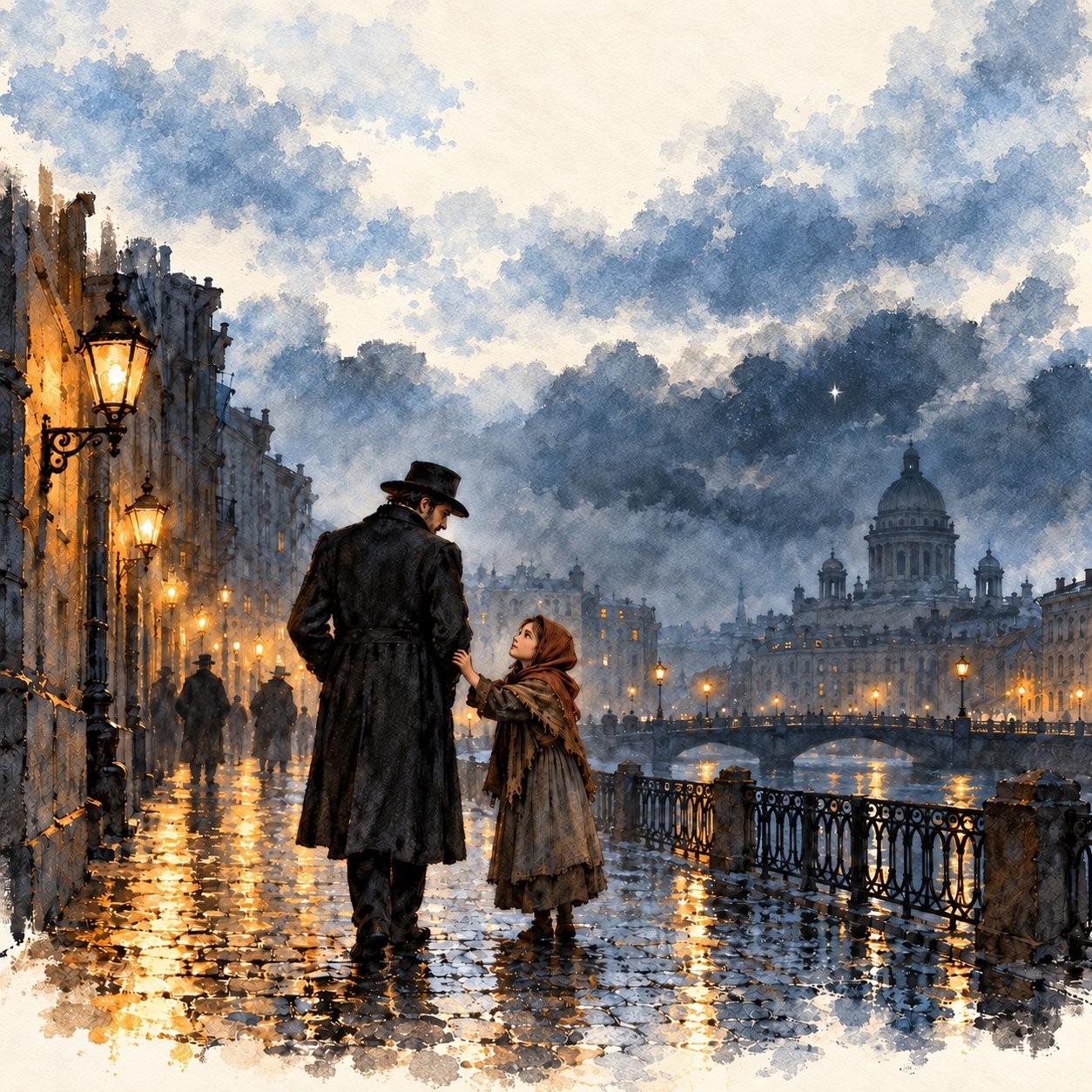
The first of my reflections on Fyodor Mikhailovich Dostoevsky’s The Dream of a Ridiculous Man, a short story first published in the April 1877 issue of A Writer’s Diary, with the subtitle “A Fantastic Story.”
Anyone who knows me knows that Dostoevsky is my favorite author. By the first chapter, he had already done to me what he does best: put me inside the head of a man whose reasoning I could follow, even when something about that reasoning did not quite sit right.
The man calls himself ridiculous. Other people think he is ridiculous too. He says he had known it about himself since childhood, and the older he became, the more convinced he was of it. What bothered him was not simply that people laughed at him. It was that they did not know that he already knew.
In his mind, nobody understood his ridiculousness better than he did.
There is a strange pride in that.
He even admits as much. He could not bring himself to tell people that he already knew what they thought of him. Somehow it mattered that they should not think they had discovered something about him before he had discovered it himself.
I found that almost funny. Even in his humiliation, he wanted to retain some advantage. They might laugh at him, but they were still behind him in understanding why.
And I wondered how often we do something similar. We announce our faults before anyone else can mention them. We turn them into jokes. Sometimes that is honesty. Sometimes we are trying to control what another person is allowed to reveal about us. It can be easier to call yourself a fool than to sit quietly while someone else explains how you have been foolish.
But with time, something changes in this man. His embarrassment begins to lose its force because he arrives at a much larger conviction: nothing matters.
The world, other people, his own existence. It all becomes the same to him.
What caught my attention was his admission that he had not actually answered the questions that troubled him. He had simply stopped caring about them. The problems had disappeared from his attention without being solved.
That is a frightening kind of peace.
He then tells us that he had decided to end his life two months earlier. Yet those two months had passed without his carrying out that decision. Every night he returned home and waited for the right moment. His explanation is peculiar: he was so indifferent that he was waiting for a moment when he would be less indifferent.
I had to pause there.
Even the decision to end everything seemed to require something from him that his indifference could not provide. He had reached a conclusion, but he had not moved beyond waiting.
Then, on a dark November evening, he notices a star between the clouds. For reasons he cannot explain, he decides that this will be the night.
The star does not give him hope at this point. It accompanies his renewed resolve. I think that detail matters, because it would be easy to make the scene more comforting than Dostoevsky wrote it.
And then a little girl takes him by the elbow.
She is frightened, soaked from the rain, and trying to find help for her mother. He understands enough to recognise that something is terribly wrong. He tells her to find a policeman. When she persists, he stamps his foot and shouts at her, and she runs towards another passerby.
He goes home.
But the encounter goes home with him.
As the story moves into the second chapter, he begins examining what happened. He had felt pity. He had felt the pull of the child’s distress. And that irritated him, because according to the position he believed he had reached, it should no longer have mattered.
Why should he feel responsible for anything when he intended to leave the world that night? Why should he feel ashamed of his conduct if everything was about to cease to exist for him?
His philosophy has moved on. His conscience has not.
That, to me, is the contradiction at the centre of these opening pages. The man can explain why the girl ought to mean nothing to him, but he cannot make the feeling disappear. His own response refuses to cooperate with his argument.
He is angry because he still cares.
Dostoevsky makes this uncomfortable by allowing him to behave cruelly. Feeling pity does not automatically make him kind. He drives the girl away, then has to live, for a little longer, with the knowledge that he did so.
I find that more convincing than an immediate change of heart. Sometimes we act against the very feeling that might have led us somewhere better. Afterwards, we keep returning to the moment, trying to explain why it still troubles us.
The girl has brought him a question he cannot dismiss. At home, one thought leads to another. He postpones what he intended to do because he wants to understand something first. Eventually, he falls asleep.
The dream will follow. But before the dream, there is this interruption.
A few years ago, I lost a friend to suicide.
That inevitably changes the way I read these pages. I cannot look at those two months of postponement as merely an interesting detail in a fictional character’s reasoning. Nor can I pass quickly over the girl’s arrival and what follows it.
I do not know what might have changed my friend’s story. I will not pretend that a novel gives me that answer. And I would not want anyone who has lost someone to read this as another reason to blame themselves for a conversation they did not have or a moment they could not foresee.
Still, I keep thinking about the time the narrator gains.
The girl does not know his intentions. She is trying to get help herself. She offers no explanation for his suffering and no persuasive speech about the value of life.
She interrupts him.
I do not mean that an interruption cures despair. It does not. But in this story, it leaves him occupied by a question when he had expected to be finished with questions. Something remains unsettled. He waits.
And when one of the available choices cannot be reversed, even a little more time matters.
That is what stayed with me before the dream had even begun: the distance between what a person declares about life and what they may still feel while living it. His conviction is real to him. So is the pity that disturbs it.
He says nothing matters.
But he cares enough to be disturbed by the fact that he does not care.
I will leave him here for now, asleep in his chair, with the questions he could not settle still unfinished. In the next reflection, I will follow him into the dream, where what he believes about death, life and his own indifference faces a very different test.
Dostoevsky has already made me pause this many times. The man has only just fallen asleep.
Source and full text
Dostoevsky, Fyodor Mikhailovich. The Dream of a Ridiculous Man (“A Fantastic Story”). First published in A Writer’s Diary, April 1877. This reflection focuses on Chapters I–II.
To read the complete story in English, see Constance Garnett’s translation, hosted by Gustavus Adolphus College (PDF).
A note to anyone struggling
If you are reading this while thinking about ending your life, please tell someone plainly what is happening. You do not have to explain it beautifully. “I am thinking about suicide, and I need you to stay with me” is enough to begin.
If you feel you might act on those thoughts, seek urgent help now. Ask someone you trust to stay with you and help you reach the nearest emergency department. Put distance between yourself and anything you could use to hurt yourself.
You do not have to settle every question about your future tonight. Let someone help you through the next hour.
Your job tonight is to reach tomorrow.
In Tanzania, call 112 for emergency/police assistance or 115 for ambulance services. If you cannot get through, ask someone to help you reach the nearest hospital.
— Faraja Majaliwa
Leave a Reply