
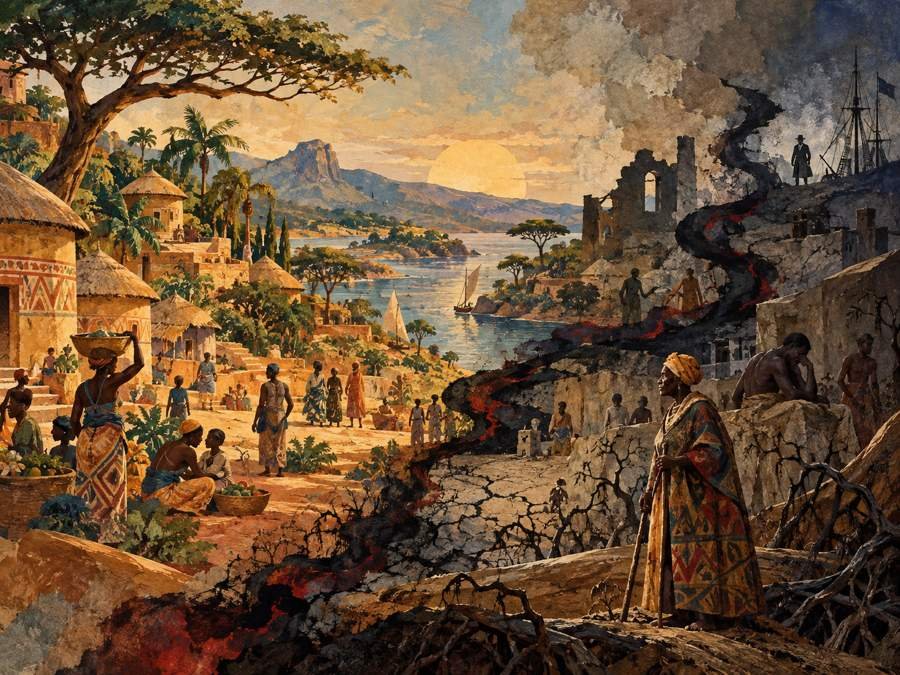
Imagine a man being asked to account for the fate of an entire civilization. Not one that he found already divided by war, greed and distrust, but a peaceful people who did not know lying as we know it, had little use for jealousy and seemed almost incapable of imagining cruelty. He arrived among them as an outsider, they welcomed him, and eventually everything changed.
Asked who caused their fall, he could blame human nature. He could say corruption was inevitable, or that somebody else would eventually have done what he did.
Instead, he points at himself.
I corrupted them all.
Adam, at least, had a serpent to point at.
This is my second reflection on Fyodor Dostoevsky’s The Dream of a Ridiculous Man, first published in 1877 in A Writer’s Diary. In the first essay, The Contradiction of the Ridiculous Man, I stopped before the dream itself. The narrator had convinced himself that nothing mattered and had decided to end his life, yet on his way home he drove away a frightened little girl who was desperately seeking help for her mother.
What disturbed him afterward was not simply what he had done. It was the fact that it disturbed him at all. If nothing mattered, why should this girl matter? Why should cruelty still produce shame in a man who had supposedly become indifferent to everything? He returned home, sat beside the revolver with which he intended to kill himself and tried to settle the contradiction.
Instead, he fell asleep.
In the dream, he does what he had intended to do while awake. He shoots himself, dies, is buried and somehow remains conscious. An unknown being then carries him away from the earth until he reaches another world remarkably like ours.
Its people, however, are different.
Dostoevsky presents them almost as humanity before the Fall. They live peacefully, love one another naturally and have not developed the complicated machinery of jealousy, deception and violence that governs so much of our own world. They do not possess our science or our elaborate systems of knowledge, yet the ridiculous man slowly becomes embarrassed by the thought that this makes them inferior. They seem to understand something about living that his own civilization has forgotten.
They welcome him.
Then he corrupts them.
When I reached that point, I immediately objected.
All of them?
Surely one person should have resisted him. I still imagine an old woman somewhere in that paradise watching this strange visitor and thinking, Whatever nonsense this man has brought from wherever he came from can remain with him.
One woman. One family. One stubborn child. Somebody who simply says no.
But Dostoevsky gives me nobody.
Falsehood enters their world, and from falsehood eventually come jealousy, cruelty, division, bloodshed and a civilization that begins to resemble the one from which the ridiculous man came.
Perhaps that is what makes the story uncomfortable. Corruption rarely requires everyone at the beginning. It requires somebody to demonstrate that a boundary can be crossed.
One official takes a bribe and discovers that it works. Another person watches. One leader lies and suffers no meaningful consequence. Another learns that dishonesty can be politically useful. The question slowly changes from Is this wrong? to Why should I be the only fool who refuses to do it?
Eventually the behaviour stops needing a defence.
That is just how things are done.
As an African, I cannot read about an outsider entering another people’s world and changing it without thinking about our own history.
The comparison with Europe’s invasion and colonization of Africa has obvious limits. Africa was not an Eden before Europeans arrived. We had wars, rivalries, inequalities, slavery and our own political failures. Colonialism was also much more than the introduction of foreign ideas. It involved conquest, exploitation, dispossession, artificial borders and systems imposed through force.
To pretend otherwise would itself be dishonest.
But there is still a question that becomes more important with every generation after independence:
What do we do with what was left behind?
Colonialism helps explain many of Africa’s present realities. Our borders did not descend from heaven. Many of our economies were constructed around extraction rather than continental development. Communities were divided, others were forced together, and political institutions were built for colonial administration rather than African unity.
We should say that plainly.
But colonialism cannot become an eternal exemption from African responsibility.
Europe does not compel an African official today to demand a bribe from another African. The Berlin Conference does not personally instruct one president to undermine another because cooperation threatens his prestige. Foreign powers continue to exploit African divisions, certainly, but those powers often succeed because they find Africans willing to make those divisions profitable.
And this is where Dostoevsky becomes more interesting than a simple story about an outsider corrupting innocent people.
The ridiculous man takes all the blame. Yet the people he corrupted eventually reject the idea that he alone is responsible. They had come to desire what they became.
Both truths matter.
The corrupter is responsible for what he introduces.
The corrupted are responsible for what they choose to preserve.
That distinction matters greatly to me as a Pan-Africanist because African unity cannot be built entirely around a shared memory of what others did to us. Memory is necessary. Historical honesty is necessary. But at some point unity also requires Africans to ask what we are doing to one another now.
And one virtue becomes unavoidable here.
Honesty.
Honesty is not merely a nice quality for a leader to possess. If we genuinely want African development through unity, honesty is political infrastructure.
A continent cannot integrate if its leaders cannot trust one another. Governments cannot build lasting economic partnerships when agreements are treated as temporary conveniences. Regional blocs cannot become meaningful if leaders preach continental solidarity in public while privately undermining neighbouring states. We cannot condemn foreign exploitation while quietly negotiating the same exploitation for personal benefit.
I am not asking for leaders who never make mistakes. Such leaders do not exist. I am asking for something much more basic: do not knowingly lie to your people. Do not make dishonesty a governing strategy. Do not speak the language of African unity while practising the politics of individual survival.
Perhaps that is why Dostoevsky’s choice of the first corruption interests me so much.
He does not begin with murder.
He begins with falsehood.
Once truth becomes negotiable, many other things become easier to negotiate with it. A lie can protect power. It can disguise theft. It can manufacture an enemy. It can make betrayal look patriotic and corruption look necessary.
And once enough people benefit from the lie, honesty itself begins to look foolish.
That brings me back to my imaginary old woman.
Perhaps every civilization needs her.
Not necessarily an old woman, of course, but someone stubborn enough to refuse what everybody else has begun calling normal. She might be a civil servant who refuses the envelope, an auditor who will not sign false figures, a voter who will not defend corruption simply because the thief belongs to his tribe—or, more popularly, belongs to his political party—or a president willing to honour an agreement with another African country even when breaking it might be politically convenient.
Goodness that survives only because it has never encountered temptation is fragile. Mature integrity knows exactly what corruption is offering and refuses it anyway.
So I understand the ridiculous man when he says:
I corrupted them all.
There is something admirable in refusing to minimize the damage one has introduced into another person’s world.
But I would not allow him to carry the whole story.
No outsider should possess another people’s conscience forever.
Someone may invade us, divide us, exploit us and leave structures that damage generations. We should name those things accurately. We should teach them. We should remember who benefited from them.
But memory should not become surrender.
At some point, the question must move from What did they do to us? to What are we doing now?
The second question does not erase the first.
It completes it.
Dostoevsky’s ridiculous man entered paradise and became the beginning of its fall. Africa has known outsiders who entered, conquered and changed much of what they found. But our future cannot be written entirely in the past tense.
What was introduced to us matters.
What we continue through ourselves matters too.
Perhaps Dostoevsky should have given me my stubborn old woman after all. Every civilization needs people capable of recognizing corruption before corruption acquires the respectable name of culture and saying:
This may have entered through somebody else, but it will not continue through me.
Because sometimes a civilization begins to fall when one person introduces a lie.
And sometimes its recovery begins when another person refuses to repeat it.
This is the second PenWhispers reflection on Fyodor Mikhailovich Dostoevsky’s The Dream of a Ridiculous Man. The first, The Contradiction of the Ridiculous Man, follows the narrator before the dream: his declared indifference to life, his encounter with the frightened little girl and the conscience that refuses to become as indifferent as his philosophy. A later reflection will return to another disturbing development in the dream: how people who once knew love without suffering eventually came to glorify suffering itself.
— Faraja Majaliwa

Leave a Reply