About seven years ago, I cared for a sixteen-year-old girl who was slowly disappearing in front of us.
She had lost a frightening amount of weight. Everything we were seeing pointed toward a malignancy involving the gastrointestinal tract, whether beginning there or spreading there from somewhere else. But in medicine, especially with cancer, strong suspicion is still only the beginning. Before anyone could confidently name what was happening to her, there were investigations to be done, possibilities to exclude and eventually specialists she needed to see.
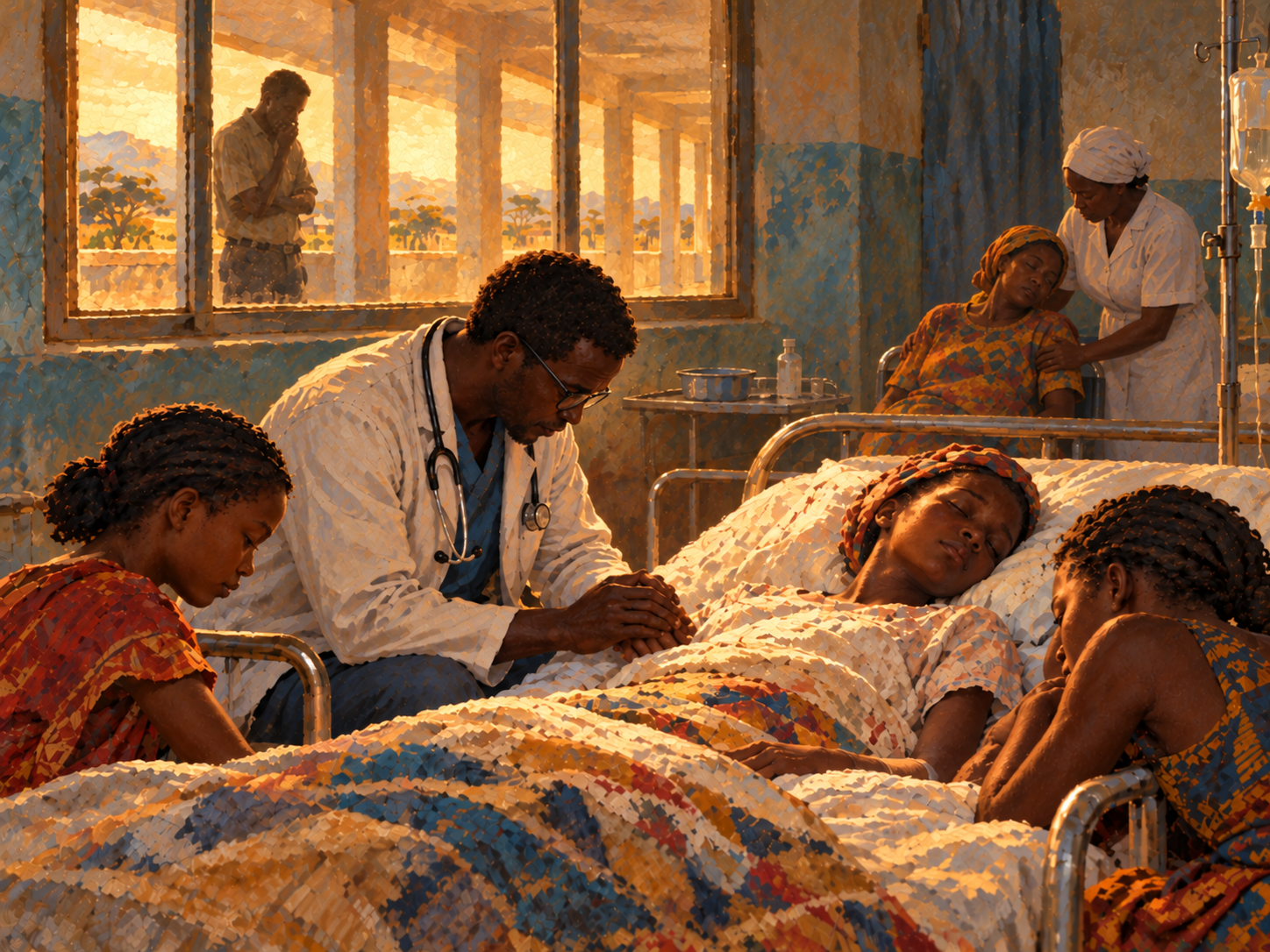
She came from a loving family. I remember her father especially. He was a humble preacher, and almost every morning he arrived early enough to pray before the ward had fully shaken itself awake. He prayed for his daughter, of course, but he would also pray for the other patients around her. His own child was wasting away in front of him, yet somehow his prayers still had room for the suffering in the next bed.
Her mother and sisters hardly left.
In an overcrowded ward where privacy was scarce and illness had a way of becoming communal, they built a little world around her bed. Someone was always nearby—watching her breathe, adjusting something, speaking softly to her, praying, waiting.
That girl was surrounded by love.
And still, she was dying.
Their problem was not that they had neglected her. Quite the opposite. By the time they reached us, the family had already chased answers far beyond what their resources could comfortably carry.
This is one of the cruelties of serious illness in a resource-limited setting. Before arriving at a diagnosis such as cancer, there are often several other possibilities that must first be investigated. One test leads to another. A scan raises another question. A procedure becomes necessary. A specialist needs to see what the first clinician could only suspect.
Medicine progresses logically.
Bills do too.
Tanzania has made important advances in specialist care and medical technology, but much of that expertise remains concentrated in relatively few higher-level facilities. For a family living on the outskirts of a city, referral does not simply mean moving a patient from one hospital to another. It may mean transport, accommodation, food, tests, procedures, medicines and days or weeks during which somebody who should be earning an income is instead sitting beside a hospital bed.
By the time we reached the point where this girl needed referral for further oncological investigation and treatment, there was almost nothing left to spend.
The family had exhausted their savings. Other resources had followed. Eventually, even their small piece of land had gone into trying to keep their daughter alive.
I still find something deeply painful in that image: a family selling part of the earth beneath them in the hope of buying more time for one of their children.
And even that was not enough.
The bills had accumulated. The investigations ahead were beyond them. The referral we needed to make might as well have been to another country.
I was part of the team caring for her, but somewhere along the way something changed in the way the family looked at me. Perhaps this happens to many doctors without our noticing. When every other option begins disappearing, the person still standing beside the bed starts to look like an option too.
Eventually, I became their last hope.
I wish medicine always rewarded that kind of trust.
It does not.
One morning, her father spoke to me with the exhaustion of a man who had reached the end of everything he knew how to do.
“She is in your hands, good doctor. Just help her last moments be as comfortable as possible.”
I do not remember giving him a remarkable answer.
What answer is there?
A father had spent what he had, sold what he could sell, prayed every prayer he knew how to pray and finally reached the point where hope itself had to change shape. He was no longer asking me to save his daughter. He was asking me not to let her suffer unnecessarily while he lost her.
The following day, during ward rounds, she deteriorated.
There are moments in medicine when a ward suddenly changes character. Conversation stops. People move faster. Instructions become shorter. Hands appear from different directions. Someone reaches for equipment. Someone calls for help. A patient who, moments earlier, was one among many beds becomes the centre of the entire room.
We tried to resuscitate her.
We did what we could.
Then we stopped.
She was sixteen.
It was only afterward that I realized her father had been standing outside the corridor window, watching everything.
Nobody had managed to get him away from there.
Perhaps nobody was strong enough to insist.
He had watched us working on his daughter from the other side of the glass, helpless as strangers pressed on the chest of the child he had prayed for, sold land for and carried from one stage of treatment to another.
Her mother had come to the same window too.
She looked in, saw what we were doing and fainted.
There is something about that scene that has never completely left me: one parent standing because he could not leave, another collapsing because she could not bear to watch, and their daughter between them, surrounded by people trying desperately to keep her alive.
After our resuscitation efforts failed, I found myself thinking aloud.
I heard myself say:
“She was loved.”
I do not know why that was the first sentence that came to me.
Perhaps because love was everywhere in her story.
Her father had loved her in prayer. Her mother and sisters had loved her by refusing to leave. Her family had loved her through every journey, every test and every bill. They had sold what they owned because, as long as there was one more thing to try, they wanted to try it.
We had cared for her. I had prayed for her during rounds. Her preacher father had prayed. Her mother had prayed. Her sisters had prayed.
And yet she died.
That realization hurt me more than I expected.
Love was not enough.
Neither, apparently, were the prayers.
Those are difficult words for me to write as both a doctor and a Christian, but pretending otherwise would make this story dishonest. Love did not cure her. Prayer did not give us the ending we wanted. Her family could not love the disease away, and I could not doctor it away with resources we did not have.
For a while, that felt like a terrible defeat of love itself.
But years later, I think I was asking love to prove itself only by saving her. Maybe that was never the only way love could prove itself. Love was there when her body became painfully thin, when the investigations became expensive, when the land was sold, when hope narrowed from Please save my daughter to Please keep her comfortable, when medicine had very little left to offer, and even when she finally stopped breathing.
She died, yes. But she did not die unwanted, abandoned or wondering whether anybody would notice that she was gone.
In suffering, she was loved. In pain, she was loved. And in death, she was loved.
Perhaps this is one of the things medicine has taught me about love that I could never have learnt from its happier expressions. We often understand love through what it prevents: a parent protects, a spouse comforts, a doctor heals, a prayer changes the outcome. But sometimes suffering removes our ability to fix anything, and love is left with a much harder question: Will you remain when you can no longer rescue me?
Her family did.
I do not say that to romanticize suffering. I would have preferred that girl to live. Her family would have preferred to keep their land. I would have preferred medicine to give us more options and their prayers to receive the answer they wanted.
There was nothing beautiful about losing a sixteen-year-old girl.
But there was something beautiful about the fact that she was not left alone inside it.
I have forgotten many patients. That is another truth doctors do not always say aloud. Faces blur. Names disappear. Cases that once occupied an entire night eventually become fragments of memory.
But some patients remain.
Once in a while, without invitation, I see her face again. I remember her father at the corridor window. I remember her mother collapsing after looking through the same glass. I remember the land that was sold, the prayers that were prayed and the strange helplessness of being the doctor everyone was looking to when I had nothing left that could save her.
And I remember the sentence that escaped me after she died:
She was loved.
As a Christian, I have also had to learn to leave some stories where Scripture itself leaves them. Paul writes:
“O the depth of the riches both of the wisdom and knowledge of God! how unsearchable are his judgments, and his ways past finding out!”
— Romans 11:33, KJV
I still do not know why that girl died at sixteen despite all that love, all those prayers and all that sacrifice.
Perhaps I never will.
But once in a while I remember her, and then I go home and hold my family a little closer.
— Faraja Majaliwa
Certain identifying details have been withheld to protect patient confidentiality.


Leave a Reply