
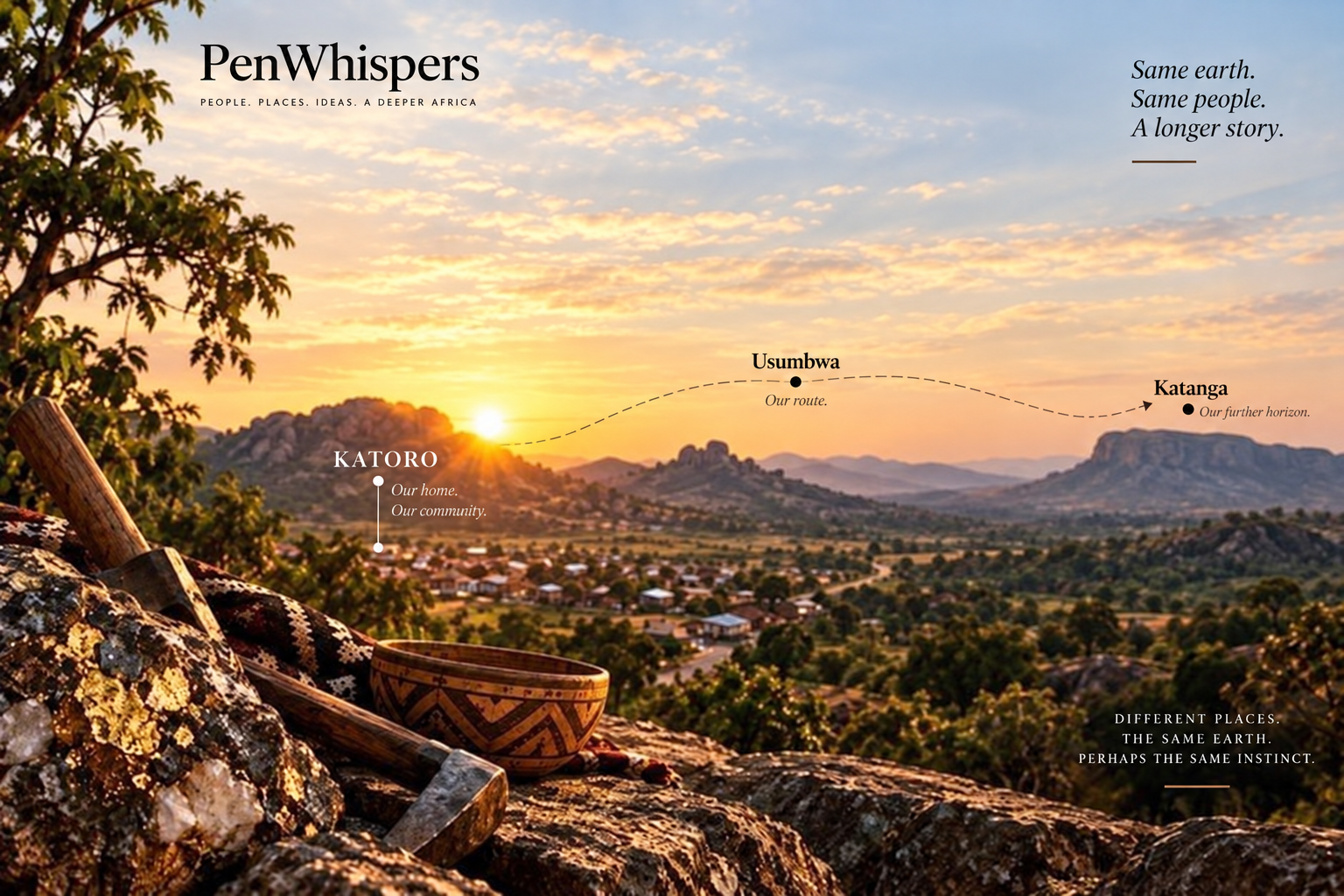
Tracing the history of my people, from a little-known community in northwestern Tanzania to an unexpected chapter of nineteenth-century Central African history.
I am a Sumbwa, but in Tanzania that sentence has often needed an explanation. This is not a distant ancestral label for me. Both of my parents are Sumbwa. My mother’s parents were both Sumbwa; on my father’s side, my grandfather was Sumbwa and my grandmother was Longo. Katoro, in Geita, is our village. So when I call the Sumbwa my people, I mean it quite literally.
There are ethnic identities whose names are immediately familiar. Say that you are Sukuma, Chagga, Haya, Hehe or Nyakyusa and most Tanzanians already have some idea of where your people come from. With the Sumbwa, the reaction is often different. I have said the name and watched someone hesitate before asking, “Wasumbwa? Hao ni wa wapi?” Who are the Sumbwa? Where are they from?
It is a curious thing to belong unquestionably to a people whom you repeatedly have to explain. The Sumbwa are not imaginary, nor are we extinct or isolated. We are simply a relatively small and little-known Tanzanian community, especially when compared with some of the country’s much larger ethnic groups. Tanzania also does not publish a modern ethnic census from which one can state exactly how many Sumbwa there are today, which means even the question of our present population is not as simple as it first appears.
For much of my life, I therefore knew that I was Sumbwa more easily than I could explain what being Sumbwa meant historically. I knew the identity because it was mine. But belonging to a people and understanding how that people came to be are two different things.
Where did the Sumbwa come from? Were we once part of the Sukuma or Nyamwezi? Was there ever one Sumbwa kingdom? How old is Usumbwa? Why is our language so closely related to those of our neighbours? And how did a people little known even inside Tanzania leave descendants hundreds of kilometres away in Central Africa?
Those questions eventually led me into a history much larger, and much less tidy, than I expected.
Usumbwa and a map that kept changing
The historical homeland of the Sumbwa is known as Usumbwa. In Kiswahili, one person is a Msumbwa, the people are Wasumbwa, the language is Kisumbwa, and the homeland is Usumbwa. Linguistic scholarship often uses the name Sisumbwa, following the language’s own grammatical form.
Today, the Sumbwa heartland lies mainly across parts of Geita and Shinyanga regions, with older communities also extending into Kagera and Tabora. Areas such as Bukombe, Ushirombo, Runzewe and Uyovu are repeatedly associated with the historical Sumbwa country.
Modern administrative boundaries, however, can easily confuse the story. Geita Region did not exist in its present form until 2012. Some Sumbwa areas described in older records as belonging to Shinyanga are now administered under Geita, while Geita itself was previously part of Mwanza Region before the new region was created. The population did not necessarily move. The political map around it did.
Older Sumbwa memory also preserves territorial names that do not fit neatly into today’s regional and district boundaries. Places such as Ushirombo, Ulangwa, Utambala, Uyovu, Busambiro, Bunzebe and Runzewe appear in accounts of old Sumbwa political territories or butemi. What is striking is how incomplete the published reconstruction remains. There is no single authoritative modern map showing every Sumbwa chiefdom, its boundaries, its ruling line and its history.
That gap would appear again and again as I read. The Sumbwa are not a people without history. They are a people whose history has never been gathered sufficiently into one place.
We did not simply break away from the Sukuma or Nyamwezi
The relationship between the Sumbwa, Sukuma and Nyamwezi is real and ancient. Sisumbwa, Kisukuma and Kinyamwezi are closely related Bantu languages, and older scholarship often placed the Sumbwa within the broad cultural region known as Greater Unyamwezi.
That wider classification, however, can easily create the wrong impression. A regional family is not the same thing as a single people. Sisumbwa is recognized as a language in its own right, with its own linguistic classification, grammar, dialect material and lexicographical record. Kulikoyela Kahigi’s Sumbwa–English–Swahili dictionary is especially important in this regard. The Sumbwa may be close relatives of the Sukuma and Nyamwezi, but closeness does not erase distinct identity.
This matters because smaller peoples are often described through their larger neighbours. Once that happens repeatedly, the language of convenience can become a false history. The smaller group becomes “almost Sukuma,” “a kind of Nyamwezi,” or merely a variation of somebody else.
The evidence suggests something more complicated. There is no strong historical basis for saying that a fully formed Sumbwa tribe once left one known country, marched into present-day Tanzania under a single leader and settled as one people. Some traditions speak of origins farther west, and these may preserve genuine memories of particular clans or ruling houses. But the history of every Sumbwa family cannot be reduced to one migration story.
The more convincing explanation is what historians call ethnogenesis: the gradual formation of a people. Related Bantu-speaking communities lived and moved through the woodland and plateau country south and west of Lake Victoria. Different lineages migrated, settled, intermarried and attached themselves to political centres. Hunters, cultivators, clients, rulers and newcomers entered local societies. Religious ideas moved across the Great Lakes region. Trade connected communities. Warfare displaced some groups and absorbed others.
Over generations, a distinct Sumbwa identity became durable through language, ancestry, territory and political belonging. That answer is less dramatic than a single founding legend, but it is probably closer to how most peoples actually form. Human communities are rarely created in one moment. They are built over generations.
The world of the butemi
Before European colonial rule, Usumbwa was not one centralized kingdom in the modern sense. Political authority was distributed among territorial chiefdoms commonly known as butemi, ruled by an ntemi or mtemi. The ntemi was not simply a government administrator. Across the wider region, rulership was closely connected to the land, fertility, rainfall, dispute settlement and ritual order. Authority rested within a network that also included lineage elders, councillors, title-holders and ritual specialists.
The political world of Usumbwa was therefore local and territorial. People belonged not only to a broad ethnic identity but also to particular communities, lineages and political centres. This is another reason why searching for one ancient “Sumbwa kingdom” may be misleading. Sumbwa political history was plural.
Daily life was shaped by the ecology of the miombo woodlands. Farming became central to most households. Maize, cassava, millet or sorghum were among the important food crops, while cotton later became significant commercially. Livestock keeping varied across communities and households, and beekeeping suited the woodland environment well.
Hunting also mattered. In particular, elephant hunting connected Sumbwa men to commercial routes far beyond Usumbwa. Ivory was one of the most valuable commodities of the nineteenth-century African interior, and the search for it drew hunters into networks spanning enormous distances.
By the nineteenth century, caravans connected the Indian Ocean coast with Tabora, Ujiji, the Great Lakes, Central Africa and lands farther west. Cloth, ivory, copper, salt, firearms and other goods circulated through these networks. Enslaved people were also transported and sold through them, meaning that commerce, opportunity, violence and exploitation existed side by side. Sumbwa hunters, traders, porters and armed caravan personnel took part in this world. Some of them travelled west, and that movement takes the story far beyond Tanzania.
From Usumbwa to Katanga
The name Katanga may not immediately mean much to every Tanzanian reader, so it is worth locating it first. Katanga is a historical region in the southeastern part of what is now the Democratic Republic of Congo, far west of Tanzania and beyond the Lake Tanganyika corridor into Central Africa. Today the region is famous internationally for its mineral wealth, especially copper and cobalt. But long before modern industrial mining, Katanga was already an important commercial and political zone.
In the nineteenth century there was, of course, no Democratic Republic of Congo. Katanga contained several African societies and political communities linked to trading systems stretching toward the Lunda world, Angola, the Great Lakes and East Africa. Copper was already mined and traded there. The region was not an empty frontier waiting for migrants; it had its own populations, rulers and rivalries.
Into that world came groups of hunters and traders from the east, including Sumbwa. Among them was a Sumbwa trader and leader known as Kalasa Mazuiri, or Mazwiri. His son would become far better known: Mwenda Msiri Ngelengwa Shitambi, usually remembered simply as Msiri.
Msiri followed the commercial routes that had drawn hunters and traders westward, but he did much more than trade. Through diplomacy, marriage alliances, firearms, warfare and control of commerce, he established himself among the political communities of Katanga and built a powerful state centred at Bunkeya. That state became known as the Yeke, or Garanganze, kingdom.
By the 1880s, Msiri controlled important trade routes and access to copper and ivory across a substantial part of Katanga. His position made him one of the major regional rulers of nineteenth-century Central Africa. This was the discovery that changed the character of my own search. I had started by trying to understand a people I often had to explain even to fellow Tanzanians. Then I found a Sumbwa leader ruling hundreds of kilometres away in Central Africa, at the centre of a state significant enough to become entangled in the European scramble for control of Katanga. For a people so little discussed, the footprint was unexpectedly large.
Was Msiri Sumbwa or Nyamwezi?
This question deserves attention because many historical accounts describe Msiri simply as Nyamwezi. The terminology is not necessarily contradictory. In the nineteenth-century caravan world, Nyamwezi could sometimes be used broadly for people from the trading societies of the interior of present-day Tanzania. It could function as a regional or commercial label rather than the precise ethnic classification that a Tanzanian might expect today.
More specific evidence, however, identifies Msiri and his father as Sumbwa. Both descriptions can therefore appear in historical sources, but Sumbwa is the more precise ethnic identification. For a small people, that precision is not trivial. History can disappear through careless categorization. If every important Sumbwa figure is absorbed automatically into the history of a larger neighbouring group, future readers may eventually conclude that the Sumbwa had no independent historical role at all.
Msiri is therefore important not because he must be turned into a tribal hero, but because his story reveals how easily Sumbwa history can be hidden inside broader labels. His kingdom was not innocent of violence. Like other states of the period, it used warfare and coercion, and it participated in the slave trade. Recovering African history does not require romanticizing it. A serious history must be able to recognize African achievement and African brutality at the same time.
The Bayeke
The Sumbwa-derived communities who settled in Katanga gradually developed an identity of their own. They became known as the Yeke or Bayeke. They were no longer simply Sumbwa people living temporarily abroad. Migration, marriage, politics and life among new neighbours transformed them. Their history became Central African as well as East African.
Yet memory of their origin survived. Bayeke royal traditions continue to connect the founding families with Sumbwa origins in Tanganyika. The line associated with Msiri survived even after the destruction of his independent kingdom, and the institution of Mwami Msiri continued among his descendants. This creates one of the most intriguing consequences of Sumbwa history: one branch remained rooted in Usumbwa, while another travelled west and became part of the history of Katanga. The two stories are related, but they are no longer identical.
Msiri and the Scramble for Africa
By the late nineteenth century, the political environment around Msiri was changing rapidly. European powers were no longer interested only in commerce or coastal influence. They were dividing African territories among themselves, and Katanga became particularly valuable because of its strategic position and mineral resources.
King Leopold II of Belgium, who controlled the Congo Free State as his personal colonial possession, wanted Katanga brought under his authority. Msiri’s independent kingdom stood in the way. In 1891, the Stairs Expedition entered his territory on Leopold’s behalf. Negotiations failed, confrontation followed, and Msiri was killed in December of that year. His death broke the political independence of the Yeke state and helped clear the way for the incorporation of Katanga into Leopold’s Congo.
The consequences extended far beyond Msiri himself. Katanga would later become one of the most economically and politically important regions of the Congo, deeply entangled in colonial mining and, eventually, the turbulent history of the independent Congolese state. There is an extraordinary historical symmetry here. At roughly the same period, Sumbwa communities at opposite ends of this story were being absorbed into different European empires. The Bayeke in Katanga entered the colonial history of the Congo, while Usumbwa was being brought under German rule in East Africa.
Colonial rule changed Usumbwa too
German conquest subordinated local rulers in the Sumbwa homeland to colonial administration. Taxation, labour demands and new administrative structures altered relationships that had previously rested on local legitimacy, lineage and ritual authority. After Germany lost its colonies following the First World War, Britain took control of Tanganyika. British indirect rule governed partly through African chiefs, but this system did not simply preserve the old butemi untouched. Colonial authorities standardized, expanded or restricted chiefly power according to administrative needs.
After independence, Tanganyika abolished official chiefly rule in 1963. Traditional titles and memories could survive culturally, but the chiefdoms no longer operated as autonomous political governments. At the same time, Tanzania was building something larger than ethnic identity. Kiswahili became central to the national project, and political leadership deliberately discouraged ethnic competition. In many respects, this was one of Tanzania’s great successes. National identity became unusually strong, and ethnicity rarely acquired the kind of political power that has torn other societies apart.
But there was another consequence, particularly for smaller peoples. When the state chooses not to organize society around ethnic identity, smaller communities can become statistically and historically difficult to see. Tanzania’s modern census does not provide an official ethnic count, so there is no scientifically precise current number of Sumbwa. Published estimates vary. One language-based calculation placed Sisumbwa speakers at a little over 360,000, while some contemporary ethnic estimates place the Sumbwa population above half a million. The figures use different definitions and methods, so they should not be treated as interchangeable. The safest conclusion is that there are several hundred thousand Sumbwa, but no exact modern official count exists.
What survives?
The Sumbwa homeland has changed enormously. Areas once described mainly through farming, livestock, hunting and beekeeping now lie within one of Tanzania’s most important gold-producing regions. Katoro, my own family’s home, is part of that transformation. What was once a comparatively small settlement has grown into a busy commercial centre closely connected to the mining economy around it.
There is an almost irresistible coincidence here. Centuries ago, Sumbwa hunters and traders travelled west and established themselves in Katanga, one of Africa’s great mineral regions. Today, the village my own Sumbwa family comes from sits within another landscape shaped profoundly by gold. Maybe it is in our blood. Or perhaps our ancestors simply had a good eye for where opportunity lay.
History will not let me claim more than that. Katanga’s people were mining and trading copper long before Msiri arrived, and there is no evidence that the Sumbwa possessed some unique technology for detecting minerals. What we can say is interesting enough: Sumbwa hunters and traders recognized opportunity, travelled enormous distances, entered established commercial networks and became powerful within them. Katoro and Katanga therefore make an intriguing bookend to this history—not proof of an inherited geological instinct, but two mineral landscapes connected, in very different ways, to the story of my people.
The question now is what else survives. Sisumbwa is still spoken, although Kiswahili increasingly dominates school, administration, media and everyday communication across ethnic lines. There is no comprehensive modern survey that allows us to declare the language endangered everywhere, but the familiar generational pattern is easy to recognize: grandparents speak naturally, their children understand but use the language less, and grandchildren inherit the identity more easily than the vocabulary.
The same can happen to history. A people can remain numerous, retain its name and know where it belongs, yet gradually lose the ability to explain itself. Clan histories disappear with elders. Old butemi become names without stories. Migration memories shrink into fragments. Eventually, someone says, “Mimi ni Msumbwa,” and knows that it is true but cannot say much about what came before.
That, more than anything, is what drew me into this research. I began with the question that has followed me for years: “Wasumbwa? Hao ni wa wapi?” I expected a geographical answer. Instead I found Usumbwa, old chiefdoms, a closely related but distinct language, nineteenth-century caravan routes, Sumbwa hunters travelling west, the emergence of the Bayeke, and Msiri building a kingdom in Katanga. I also found how much remains unwritten.
Somewhere in our families are still the names, migrations, marriages, graves and memories that scholarship cannot recover for us. My own family is part of that unfinished history: Sumbwa on both sides, with a Longo grandmother on my father’s side, and Katoro as the place our story calls home.
So I can answer the old question better now. The Sumbwa are a people of northwestern Tanzania whose homeland is Usumbwa, closely related to the Sukuma and Nyamwezi but historically distinct from both. Part of their nineteenth-century story travelled far beyond Tanzania and became part of the history of Katanga. And for me, that history eventually returns to Katoro.
Perhaps that is where the next search should begin.
— Faraja Majaliwa
Leave a Reply