Nas gave hip-hop its most famous verdict on “Renegade.” More than two decades later, does the evidence still support it?
I should declare my qualifications before judging two of the greatest rappers ever: I was once an amateur battle rapper.
My greatest adversary was a rapper called Menroe Ruin, whom I faced during high school at Neema Trust Secondary School. My musical career did not travel much further than that. Perhaps I made the responsible decision.
Or perhaps the world was denied something extraordinary. We may never know.
But that brief experience taught me one thing about battle rap: the audience rarely remembers every line. It remembers the moment that felt fatal.
That is what happened to Jay-Z on “Renegade.”
Some rap verses belong to songs. Others escape them and become mythology. Eminem’s performance on “Renegade” belongs to the second category.
Released on Jay-Z’s 2001 album The Blueprint, the song paired two rappers near the height of their powers. Jay-Z was making his case as the greatest rapper alive. Eminem was popular music’s most provocative and technically dazzling figure.
The collaboration should have been remembered as a meeting of equals.
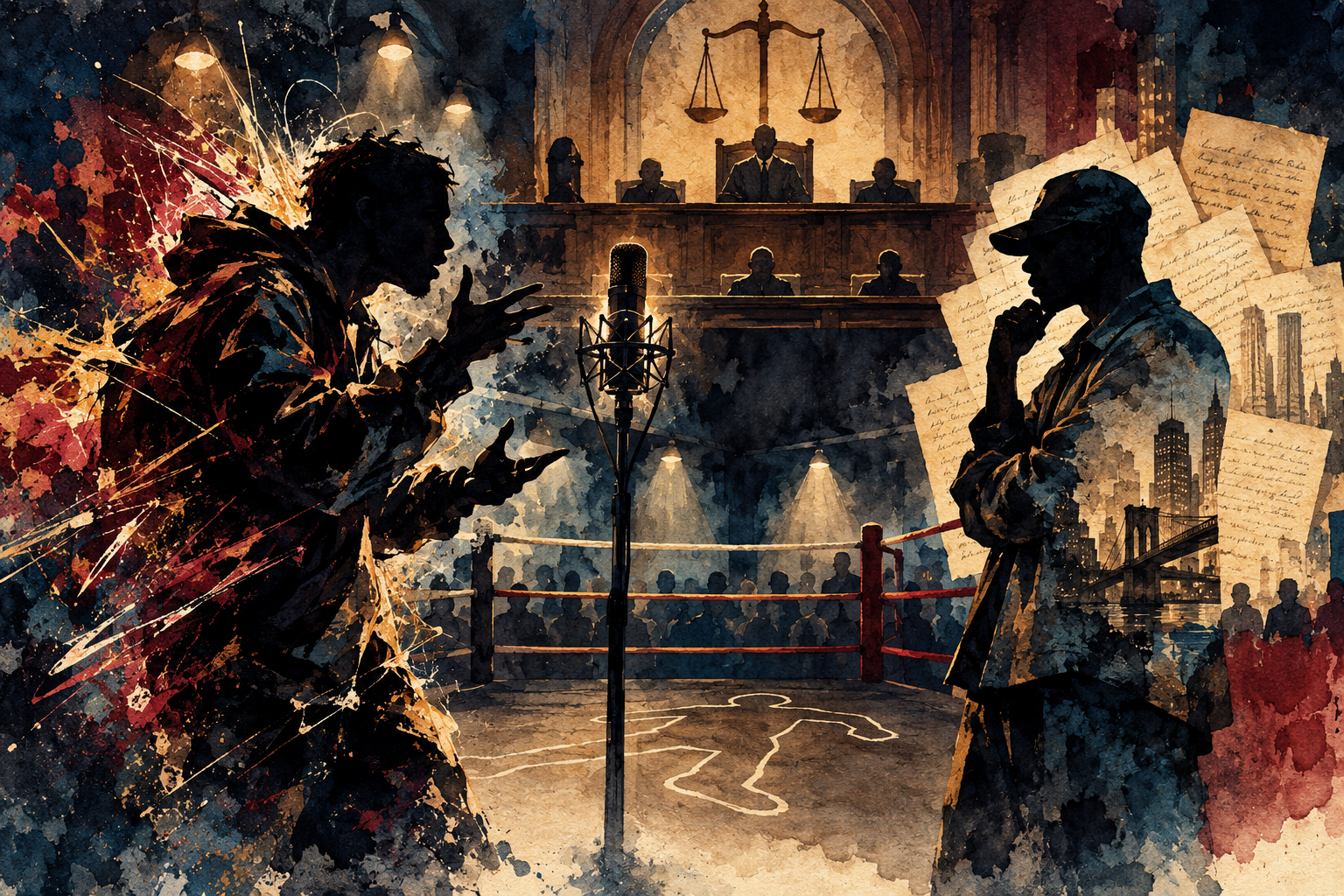
Instead, it became a murder scene.
During his feud with Jay-Z, Nas declared on “Ether” that Eminem had murdered Jay on his own song. The accusation landed because many listeners already suspected it was true. Nas did not invent the opinion; he gave it its most memorable form.
Since then, the verdict has hardened into hip-hop law:
Eminem destroyed Jay-Z on “Renegade.”
But did he?
The scene of the alleged crime
“Renegade” was not created as a neutral contest between Jay-Z and Eminem.
The song began as an Eminem and Royce da 5’9” collaboration before being reworked for The Blueprint. Eminem produced the track, shaped its atmosphere and performed the chorus. Its dark, restless sound already belonged to his world.
Jay-Z was entering Eminem’s architecture.
But because the song appeared on Jay-Z’s album, Jay remained the host. In rap, that creates a special burden: when the guest sounds better, the host is accused not merely of losing, but of being humiliated at home.
Even in my considerably less historic encounter with Menroe Ruin, I understood that the setting matters. Losing is one thing. Losing before your own audience is another. The crowd does not calmly evaluate rhyme patterns and thematic depth. It senses blood—or thinks it does—and joins the execution.
That is the standard Jay-Z has faced ever since.
The case for Eminem
Eminem’s advantage is immediately audible: his verses feel engineered.
His internal rhymes arrive in dense clusters. Sounds echo within and across lines. His cadence changes without losing the beat. Even listeners who are not studying the lyrics can hear the technical control.
His delivery is equally powerful. Eminem sounds hunted, furious, defensive and dangerously amused—sometimes within the same passage. He turns the song’s rejected outsider into a living character.
Jay-Z describes a renegade.
Eminem sounds like one.
That distinction matters. Eminem’s public identity was built around conflict with parents, politicians, journalists, religious groups and cultural gatekeepers. When he challenges adults who condemn his music while ignoring what is happening in their children’s lives, he is not discussing public outrage from a distance.
He is answering an indictment.
If “Renegade” were judged only on rhyme construction, vocal dexterity and dramatic performance, Eminem would win clearly.
The case for Jay-Z
Jay-Z’s performance is less spectacular but more layered than its reputation suggests.
His concern is not simply that society misunderstands him. He examines why society is fascinated by the people it publicly condemns. The rapper becomes both criminal and commodity, sinner and spectacle. Society denounces the renegade while buying his story, copying his language and profiting from his image.
Jay-Z presents himself as a product of an environment outsiders judge without understanding. Success does not erase the conditions that shaped him; it makes those conditions marketable.
The two rappers therefore approach the song from different directions.
Eminem asks: Why do you blame me for what is happening to your children?
Jay-Z asks: Why do you condemn me after creating—and consuming—the world that made me?
Eminem represents the cultural outlaw accused of corrupting society. Jay-Z represents the social outlaw produced by inequalities society refuses to confront.
Jay-Z is also more restrained. He does not attack the beat with Eminem’s acrobatics. He speaks like someone presenting testimony. His conversational style makes difficult ideas sound effortless—but listeners often reward the effort they can hear.
Eminem displays his technique.
Jay-Z conceals his.
Are we confusing intensity with victory?
Imagine two actors performing the same scene. One delivers an explosive emotional performance. The other speaks quietly, revealing the character through controlled language and carefully chosen pauses.
The first will probably dominate the conversation. That does not mean the second lacks power.
Something similar happened on “Renegade.”
Eminem’s brilliance is impossible to miss. Jay-Z’s requires closer attention. One performance seizes the listener; the other waits for the listener to enter it.
Battle rap makes this difference especially important. You can construct the more thoughtful argument and still lose the room to someone with greater force, timing and presence. I learned enough from facing Menroe Ruin to know that what survives in the audience’s memory is not always the most layered idea. Sometimes it is simply the line—or performance—that produces the loudest reaction.
This does not mean Eminem’s advantage is an illusion. His writing is exceptional. But judging Jay-Z only by Eminem’s preferred weapons—dense rhymes, rapid cadence changes and vocal aggression—guarantees Eminem victory before the contest begins.
A fair comparison must also consider argument, perspective and thematic depth.
By those standards, Jay-Z closes the gap.
Did Jay-Z lose?
Yes.
Eminem delivers the stronger overall performance. His verses are more technically impressive, emotionally volatile and instantly memorable. Because he also produced the track and carried the chorus, his presence defines the record.
Remove Eminem, and the song’s identity changes completely.
Remove Jay-Z, and it loses much of its social breadth—but probably remains recognisably “Renegade.”
That is the clearest evidence of Eminem’s victory: the song depends more on him.
But losing is not the same as being murdered.
Calling it murder suggests Jay-Z embarrassed himself, contributed inferior writing or became unnecessary on his own song. None of those claims survives scrutiny.
His verses are thoughtful and central to the song’s meaning. He expands the renegade beyond personal rebellion, connecting him to poverty, race, religion, criminality and commercial exploitation.
A murdered rapper does not leave behind verses still worthy of serious analysis decades later.
Jay-Z lost to an extraordinary performance. He did not collapse beneath it.
Why Nas’s verdict survived
Nas’s accusation survived because it was more entertaining than the truth.
Saying Eminem performed somewhat better while Jay-Z contributed substantial thematic depth would not have damaged anyone’s reputation. Nas transformed a debatable difference in performance into a public execution.
That is what battle rap does. It takes an insecurity, sharpens it and gives the audience a sentence simple enough to repeat forever.
As a former amateur battle rapper—and I am stretching the word “career” generously here—I understand the power of that simplification. Nobody leaves a battle saying one rapper showed slightly superior technical control while the other offered greater thematic complexity.
They say someone got killed.
Nas supplied that language. The audience supplied the legend.
The final verdict
Eminem won “Renegade.” He did not murder Jay-Z.
Eminem had the superior rhyme construction, vocal dynamism and dramatic performance. He sounds more urgent, dangerous and at home within the production.
Jay-Z, however, provided the broader social argument. His verses turn the track into a conversation about whom society labels dangerous, how it creates such people and why it continues to consume them.
Eminem was the better rapper on the record.
Jay-Z may have been the better essayist.
The murder narrative survives because Eminem overwhelms the senses before Jay-Z’s ideas have time to settle. But under closer examination, there is no body at the scene.
Only two exceptional rappers, one exceptional song—and a guest who won more decisively than his host would have preferred.
Eminem did not murder Jay-Z. He murdered the listener’s ability to notice how good Jay-Z actually was.
As for Menroe Ruin and me, history has been strangely silent about who won our encounter at Neema Trust Secondary School. Perhaps a rematch is required.
Then again, perhaps some legends are safer in retirement.
The Great Debate
What should decide victory on a collaborative rap song: technical complexity, emotional force, thematic depth—or simply the performance listeners remember?
Who won “Renegade”—and was it really murder?
— Faraja Majaliwa
Leave a Reply